


Description: How Neelitech designed an AI extraction solution that converts multi-site, multi-language electricity and natural-gas invoices into standardized, reconciliation-ready data.
Tags: Document Intelligence, Generative AI, Finance Operations, Prompt Governance
A repeatable way to turn utility invoices into clean, comparable data
A governed AI extraction platform for electricity and natural-gas invoices. It works across any site, in any supported language, and produces standardized spreadsheets ready for reconciliation.
At a glance (ROI)
- 2 sectors: One generalized AI prompt each: electricity and natural gas
- 2 workbooks: A standardized Summary and Detail file per sector, for every site
- 7.2 weeks: Proposed delivery window, from discovery to hypercare
- 100%: Prompt changes driven by evidence, versioned and regression-tested
Client context
Our client is a multi-site organization that receives electricity and natural-gas invoices from many locations, in different formats and languages. Finance teams needed that data in one consistent, audit-ready form, without rebuilding the process every time a new site came on board.
The challenge
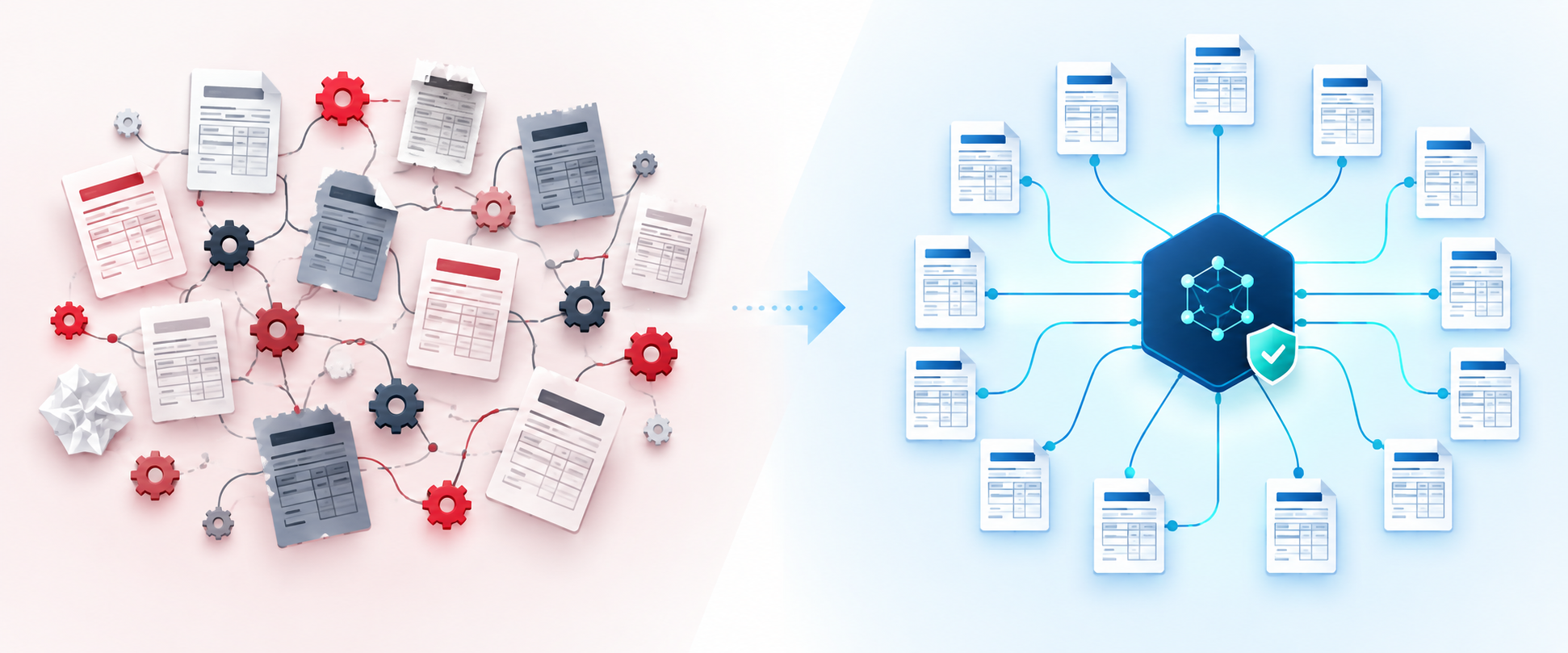
No standard format. Invoices from different sites looked different, even within the same utility type. A script tuned to a few samples would not hold up.
Scanned and non-English invoices. Some invoices were images, not text. Others were not in English. Both had to be handled before extraction could begin.
Nothing reconciliation could rely on. There was no consistent, audit-ready output that downstream teams could trust across sites and sectors.
Fixes that break other things. In AI extraction, fixing one site's problem can quietly break another's. The solution needed a way to improve without regressing.
Our approach: one prompt per sector, not one per site
Instead of building a custom prompt for every site, we designed one generalized, governed prompt per sector. It is engineered to work across every approved site, including sites added later.
- Language handled upfront. The pipeline detects the source language and translates non-English content to English before extraction. Anything that can't be translated goes to review, never through silently.
- Two routes, one outcome. Text-based PDFs are converted and read directly. Scanned or unreadable files automatically fall back to AI vision processing.
- Standardized outputs. Every sector produces a Summary workbook (invoice level) and a Detail workbook (line-item, meter and consumption level). Both are schema-versioned and validated before handoff.
- Disciplined onboarding of new sites. A new site is first tested against the existing prompt. The prompt is changed only when the evidence requires it, followed by a full regression check across the sector.
How it works
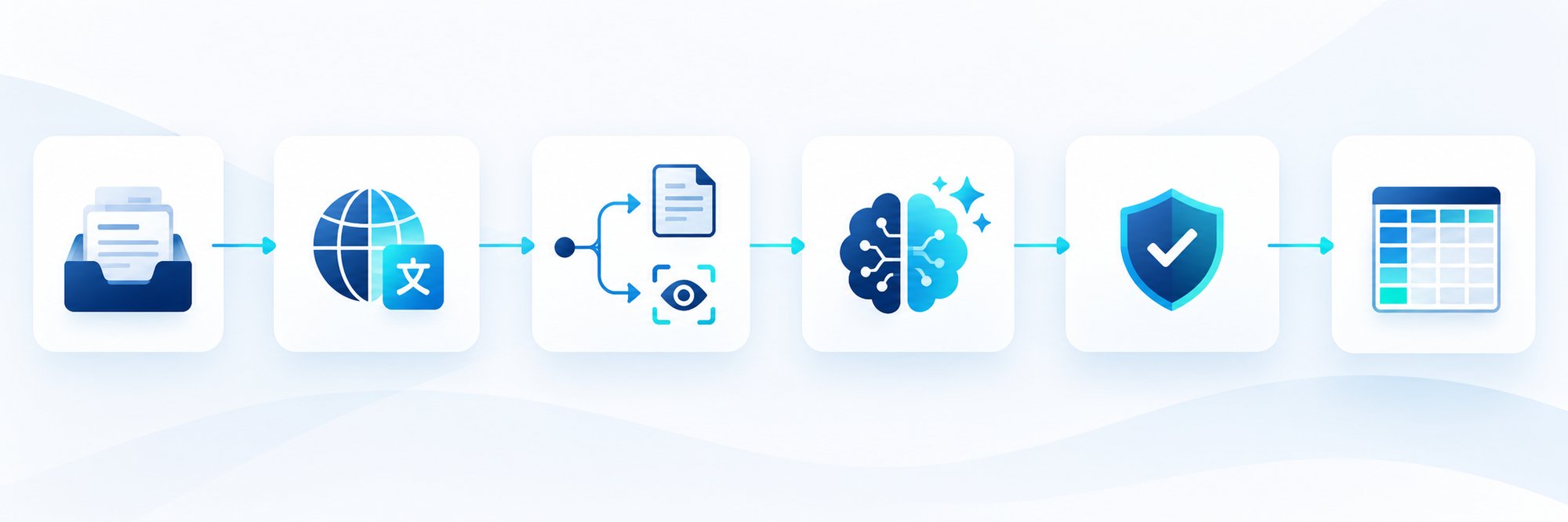
- Intake: Invoices are picked up from the source, matched to their sector and site, and checked for duplicates.
- Language and format check: The source language is identified and non-English content is translated.
- Smart routing: Text PDFs go through conversion; scanned files go to vision processing.
- AI extraction: The approved sector prompt extracts the data.
- Validation: Structure, field rules and duplicates are checked, and values are normalized.
- Output: Summary and Detail workbooks are generated and handed off, or flagged for manual review.
Governance: every prompt change has to earn its place
This is what makes the solution durable. The human-reviewed spreadsheet is always the source of truth, never the model's own earlier output.
- Every failure is classified before the prompt is touched: conversion issue, source-document issue, schema issue, model issue, or an error in the reference data.
- Only reusable, sector-level corrections are applied, and each one becomes a new, versioned prompt.
- Every candidate is tested against the full regression set and a protected holdout set the prompt has never seen.
- A prompt is approved, rejected or returned for refinement. It is never patched silently.
- A site that still can't validate is referred for separate scope review, not approved by default.
Delivery approach
Delivery runs in five phases: Discovery & Design → Implementation → Testing → UAT → Go-Live & Hypercare. Each has clear exit criteria and sign-off. Testing covers six layers, from individual components through to business acceptance, so a change at one site is proven not to break another before it reaches production.
The scope was also defined upfront. Electricity and natural-gas extraction, prompt governance and new-site tuning were in scope. Additional sectors, production hosting, identity integration and post-handover operations were treated as separately estimated changes.
What this delivers
- A repeatable extraction capability for multi-site, multi-language utility invoices
- Standardized, audit-ready data that reconciliation teams can rely on
- Confidence in change, because every improvement is evidence-backed, versioned and regression-tested
- A pattern that scales, since the governance model can extend to further invoice types without starting from scratch
Built for any organization with many sites
Utility invoices are the use case, not the industry. Any organization that receives electricity or natural-gas invoices from many locations, in different formats and languages, can use the same approach.
- Retail & Hospitality: Stores, hotels and restaurants spread across many locations, each with its own utility providers.
- Manufacturing: Plants and warehouses across regions, billed in different formats and languages.
- Real Estate & Property: Commercial portfolios with utility invoices to consolidate across buildings.
- Healthcare: Hospitals and clinics across sites, where energy invoices need consistent tracking.
- Education: Campuses and institutions with many meters, accounts and invoices.
- Logistics & Warehousing: Depots, hubs and distribution centres, often across several countries.
- Banking & Financial Services: Branch and office networks generating high volumes of similar invoices.
- Telecom & Data Centres: Exchanges, towers and facilities with heavy, ongoing energy consumption.
If your invoices come from many sites, in many formats, this pattern applies.
Drowning in invoices that all look different?
Neelitech designs governed AI document-processing solutions that turn unstructured documents into data your teams can trust.